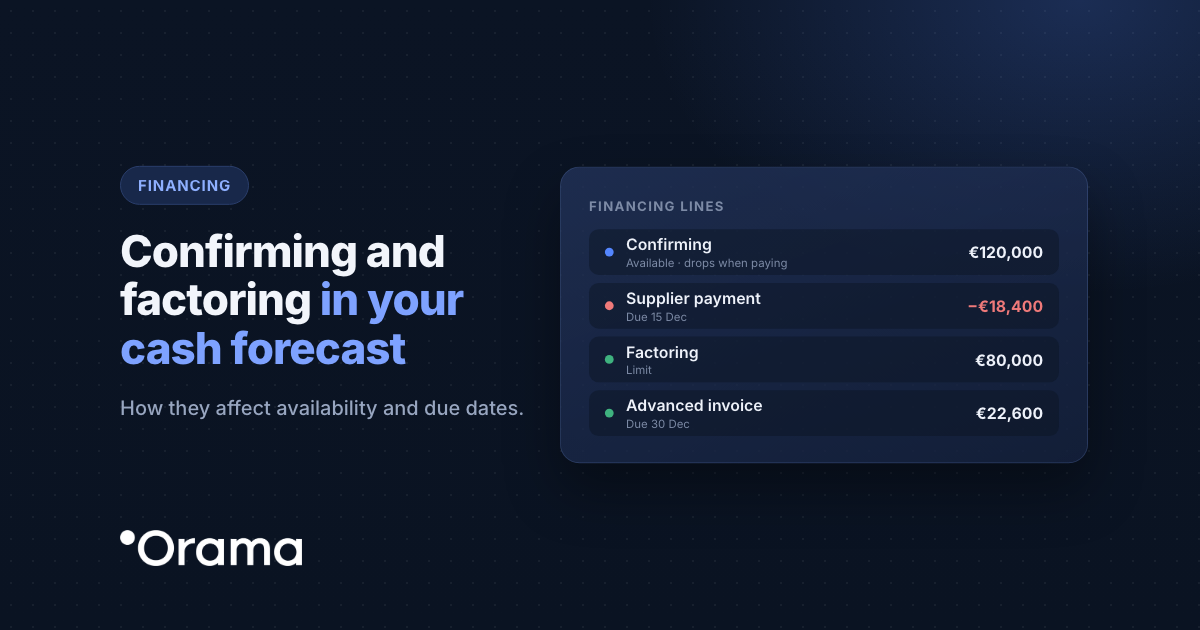
In a cash flow forecast, reverse factoring (confirming) and factoring have two dates that matter. With confirming, the day you pay the supplier invoice you use part of the line’s limit, and on the due date the bank charges your account while the limit is restored. With factoring, the net advance reaches your account the day you receive it, and on the due date the bank recovers the amount. If your forecast keeps the original invoice and the bank movement as well, you count the same payment or receipt twice and your future cash position stops being reliable.
What confirming and factoring are
Both are working capital finance, but each is arranged by a different side of the invoice:
| Confirming (reverse factoring) | Factoring with recourse | Non-recourse factoring | |
|---|---|---|---|
| Who arranges it | The payer (you, to pay suppliers) | The seller (you, with your customer invoices) | The seller (you, with your customer invoices) |
| What the bank does | Pays your suppliers (or advances their payment) and you pay the bank on the due date | Advances the invoice amount to you and later collects it from the customer | Advances the amount and takes over the invoice |
| If the customer does not pay | Not applicable: you still owe the bank | The bank claims the amount back from you | The bank bears the default risk (as agreed) |
| Cost | For you, the agreed fee; the supplier pays the interest on any early payment | Interest + fee | Higher interest + fee, because the bank takes the risk |
| Effect on your cash | Delays or fixes the outflow at the confirming due date | Brings the receipt forward | Brings the receipt forward and removes the risk |
On “how to account for confirming”: how it is booked on the balance sheet is your accountant’s call; in the cash flow forecast all that matters is when and how much money leaves or enters your account.
The double-counting mistake and how to avoid it
Double counting appears when two forecast items exist for a single real cash movement:
- Confirming: your ERP holds a €30,000 supplier invoice due on 15 March, and you have also forecast the bank’s €30,000 charge on 15 June. The forecast shows €60,000 of outflows, but only €30,000 will leave, and in June, not March.
- Factoring: you factor a €60,000 customer invoice and receive €58,950 today. If the invoice is still forecast as a receipt on 30 April, your forecast counts €118,950 of receipts where there will only be €58,950.
To avoid it, follow these steps:
- One forecast item per real movement in your account. This is the golden rule for both confirming and factoring.
- Confirming: forecast only the bank’s charge, on its due date and including the fee. The supplier invoice remains a reference for what you sent to confirming, not a cash outflow.
- Factoring: as soon as you factor an invoice, replace its expected receipt on the due date with the net advance (amount minus interest and fee) on the date you receive it.
- Factoring with recourse: keep an eye on factored invoices until they are due. If a customer does not pay, the bank will charge you the amount, and that outflow was not in your forecast.
- Reconcile every charge and every advance with its forecast item when it reaches the bank.
Effect on your cash position, your credit lines and your forecast
| Confirming | Factoring | |
|---|---|---|
| Cash position today | Unchanged until the due date: the money stays in your account | Goes up on the advance date, by the net amount |
| Line limit | Each invoice sent uses up limit until you pay the bank | Each invoice factored uses up limit until the customer pays the bank |
| Forecast | The outflow moves to the confirming date | The receipt comes earlier and is reduced by the cost |
Watch the limit: you can have cash and still be unable to factor more invoices because the line is used up. Look at the balance and the drawn amount of each line together.
How to decide which invoices to factor and what they really cost
Take a distributor with €4M in revenue and a factoring line at 5% annual interest. It has three candidate invoices:
| Invoice | Amount | Due date (days) |
Interest | Fee | Total cost |
You receive today |
Equivalent annual cost |
|---|---|---|---|---|---|---|---|
| Customer A (creditworthy) | €60,000 | 90 | €750 | €300 (0.5%) | €1,050 | €58,950 | 7.1% |
| Customer B (creditworthy) | €20,000 | 20 | €56 | €100 (0.5%) | €156 | €19,844 | 14.2% |
| Customer C (pays late), non-recourse at 6% | €40,000 | 60 | €400 | €320 (0.8%) | €720 | €39,280 | 11.0% |
The equivalent annual cost is: total cost ÷ amount received × 360 ÷ days. For invoice A: 1,050 ÷ 58,950 × 360 ÷ 90 = 7.1%.
What the example shows:
- The fee weighs heavily on short terms. Invoice B looks cheap (€156), but it is equivalent to 14.2% a year. If you are only 20 days short, drawing on your credit line is usually cheaper.
- Long terms from creditworthy customers are the best candidates. Invoice A comes out at 7.1%.
- Non-recourse buys peace of mind. Invoice C costs more, but it removes the risk of a customer who pays late.
- Factor only what your forecast says you need. If it shows a €50,000 gap in six weeks, factor that amount close to that date, not everything the line allows.
What happens if the bank does not renew the line
“The bank won’t renew my credit line” applies to confirming and factoring too. If they are not renewed:
- Without factoring, you stop bringing receipts forward: customers pay on their natural due date again and a cash gap opens up equal to what you used to factor each month.
- Without confirming, suppliers will want to be paid on their invoice due date, which is usually earlier than the confirming date: your payments come forward.
- Without a credit line, you have to repay the drawn amount on the maturity date.
How to prepare:
- Check three to six months in advance when each product matures.
- Size the gap: how much you factor or send to confirming on average each month, and how much you have drawn on each line.
- Simulate a “no renewal” scenario and compare it with your forecast, with and without credit lines.
- If the scenario goes negative, negotiate early with another bank, speed up collections or agree terms with suppliers.
How Orama handles it
Orama brings all your financial products into the forecast: credit lines, loans, cards, confirming and factoring.
- Activated like a bank account: you don’t set up confirming or factoring by hand. When you connect your bank, you choose which of its products to bring into Orama and they appear in their own tab under Credit products, alongside your credit lines and loans.
- No double counting, no setup: when you pay an invoice with confirming, Orama reconciles that transaction with the supplier invoice forecast (if the transaction includes the supplier’s name, it matches it automatically) and your available funds go down that day. Orama also creates two forecasts for the due date on its own: the outflow from your current account and the restored limit, for the same amount, so your available funds don’t change when it falls due. With factoring, Orama marks the advanced invoice as collected and forecasts the outflow and the restored limit the same way, so the receipt is never counted twice.
- Everything in view: you see confirming and factoring alongside the rest of your cash in the cash flow table, and in Lists you can filter confirming transactions.
- Drawn credit: the dashboard shows, product by product and in total, how much limit you have used and available, in green, amber or red depending on the usage percentage.
- Debt report: gross and net debt, available liquidity, maturities over the next 12 months, and warnings about heavily used lines or lines close to maturity.
- Scenarios: in Daily cash and Scenarios you see your forecast cash with and without credit lines, and can simulate what happens if a line is not renewed.
Orama connects with 100% of banks in Spain and 3,000+ across Europe and Latin America (updated up to 4 times a day) and with your ERPs to build your cash flow forecast over 12, 18 or 24 months.
Step by step in Orama Academy (in Spanish): Reconciling confirming, Credit products, Drawn credit and Debt report.
Want to see it with your own data? Start the 7-day free trial, no card required, or book a 30-minute demo. If you still work in Excel, start with our 13-week cash flow template.
Keep reading: you may also want to see what cash flow is and how to calculate it, how to see the cash of a group with several companies and how many days of cash your business has.
Frequently asked questions
How is confirming reflected in the cash flow forecast?
At two moments. The day you pay the invoice with confirming, the invoice is settled and you use part of the line’s limit. On the due date, the bank charges your account and the limit is restored by the same amount. The supplier invoice must not create a second outflow on its original due date. In Orama, the due-date forecasts are created automatically.
And factoring?
As an early receipt for the net amount (invoice minus interest and fee) on the date the bank pays it to you; the invoice is marked as collected and its expected receipt on the due date disappears. On the due date, the customer usually pays you and the bank takes that amount from your account. In Orama, these forecasts are created automatically and the receipt is never counted twice.
Are confirming and factoring debt?
While drawn, they use up limit on your lines and count as financing. With recourse factoring, you also remain liable if the customer does not pay.
Which invoices are worth factoring?
Those from creditworthy customers with long terms, because the fee is spread over more days. On short terms the equivalent annual cost shoots up. Always calculate it before factoring.
What do I do if the bank won’t renew my credit line or factoring line?
Check well in advance when it matures, size the cash gap it would leave and simulate a scenario without that line. If cash goes negative, negotiate with another bank or adjust terms before the maturity date.