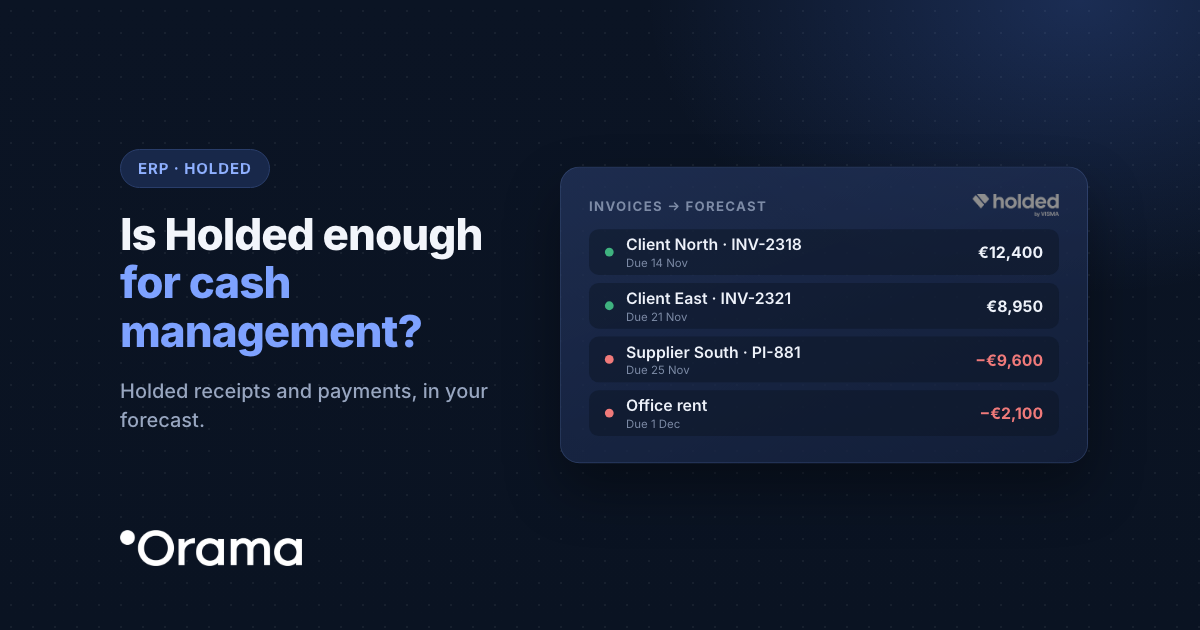
Holded doesn’t fall short for invoicing and bookkeeping, but it tells you what you’ve invoiced and what you’re owed, not how much cash you’ll have in each week of the coming months. That’s where Orama comes in: every 2 hours it reads your Holded invoices, credit notes, payments and batches, matches them against your banks and builds your cash flow forecast, without changing the way you work in Holded.
If you invoice with Holded but still track cash in a spreadsheet, this article covers what Holded does well, which part of cash management it leaves out, what data Orama syncs, what you need to connect it and how it all works for an example SME.
What Holded does well and what it doesn’t cover on cash
Holded is built so an SME or a freelancer can invoice, keep the books and track stock without spreadsheets. It tells you what you’ve invoiced and what you’re owed; it doesn’t tell you how much cash you’ll have next month.
| Topic | What Holded does well | What cash management also needs |
|---|---|---|
| Invoicing | Creates quotes, invoices and credit notes in a few clicks. | Every invoice and credit note becomes an expected collection or payment on its due date, automatically. |
| Payments | Marks invoices as paid when you record the payment. | That payment closes the forecast even if the transaction hasn’t reached the bank yet. |
| Batches | Generates SEPA direct debit batches. | See the batch broken down into its collections inside the cash flow. |
| Banks | Syncs or imports transactions from the accounts you connect. | Every account, card and credit line together, with balances up to 4 times a day. |
| Decisions | Shows you what has already happened. | Simulate before deciding: hiring, investing, or what happens if a customer pays late. |
What Orama syncs from Holded, and how often
- Sales and purchase invoices, with their amount and due date.
- Credit notes, which are deducted from the forecast.
- Recorded payments: if you record a payment in Holded, the forecast item is marked as collected or paid even before the transaction reaches the bank.
- Collection and payment batches.
Orama syncs your Holded data every 2 hours, Monday to Friday. With your banks connected via PSD2, read-only, Orama matches each transaction to its Holded invoice: 80–95% reconcile on their own and the rest wait for you in Tasks.
Requirements
- A Holded account with access to Settings › Developers.
- An API key created by an admin user. If a user without admin rights creates it, only sales invoices may come through.
- Version 2 of the API, which is the one Orama uses.
How to connect Holded to Orama
- In Holded, go to Settings › Developers › API keys, click New API key, give it a name such as “Orama” and copy the key.
- In Orama, click the settings cog › Integrations and open the Holded card.
- Leave v2 selected and paste the key. Orama checks the connection and within a few minutes your invoices will appear under Lists › Invoices.
The step-by-step guide, with Holded screenshots, is in Orama Academy (in Spanish): Connect Holded to Orama (in Spanish).
Common issues with Holded and how to fix them
| What happens | How to fix it |
|---|---|
| Only sales invoices come through | The API key was created by a user without admin rights. Generate a new one from an admin user and update it on the Holded card. |
| The key is rejected | Check it has no spaces and that API version v2 is selected. |
| Nothing shows right after connecting | The first sync takes a few minutes. If it stays empty, check the key user can see invoices in Holded. |
| No update over the weekend | That’s expected: the Holded sync runs Monday to Friday, every 2 hours. |
Example: an installation company that invoices with Holded
Instalaciones Turia (anonymised name) is an air-conditioning installer in Valencia with an annual turnover of €2.5M. It invoices with Holded, works with three banks and gets paid by customers at 60 and 90 days, while paying for materials at 30. The managing director knew what was owed, but not whether there’d be enough to cover everything at month end: every Friday they cross-checked statements from all three banks against the outstanding receivables report in a spreadsheet.
With Orama, Holded is connected with an API key and the three banks are authorised. Every outstanding invoice becomes an expected receipt or payment, and when a payment is recorded in Holded, the forecast updates even if the money hasn’t shown up in the bank yet.
In April, the forecast shows that in June, peak season for installations, equipment purchases (€210,000) have to be paid before the receipts from those jobs come in, which slip to August and September. Add the July extra month’s salary that Spanish employers pay, and cash falls to €15,000 in the first week of July. With two months’ notice, the director negotiates 60-day terms with the distributor on part of the materials and asks two customers for a deposit on signing, rather than plugging the gap with an overdraft.
More on ERPs and cash management: Is your ERP falling short on cash management? and the Orama Academy article Connect Holded to Orama (in Spanish).
If you invoice with Holded and want to know how much cash you’ll have in the coming weeks, connect your account in the 7-day free trial (no card) or book a 30-minute demo.
Start the free trial · Book the demo
Frequently asked questions
Keep reading: you may also want to see what treasury software for an SME should include, when a spreadsheet is enough and when you need treasury software and what cash flow is and how to calculate it.