
Whether you are a small or large company, an expense is always something you are trying to reduce. Therefore, knowing how a company can make savings is one of the keys to having an optimised income statement (i.e., that our expenses have the least impact on the bottom line).
Here are some tips to help you optimise your finances and save money. The key is, as on many occasions, to reduce expenses down to the smallest details. It is not a matter of simply making cuts, but of reviewing your processes in order to optimise them.
Before cutting: when and how to reduce costs
Cost optimisation should not only happen in times of crisis: ideally, cost control is permanent. That way you avoid unnecessary costs that are not essential to making your product or providing your service. In difficult times, however, cutting costs stops being advisable and becomes almost mandatory.
Bear in mind, too, that reducing expenses is a limited measure: some costs are essential to your activity, and the company cannot operate without them. So, before making any decision, answer three questions:
- Are you clear about what can happen in your business?
- Do you have a clear view of your company’s collections and payments?
- Do you have a cash flow forecast for the coming months?
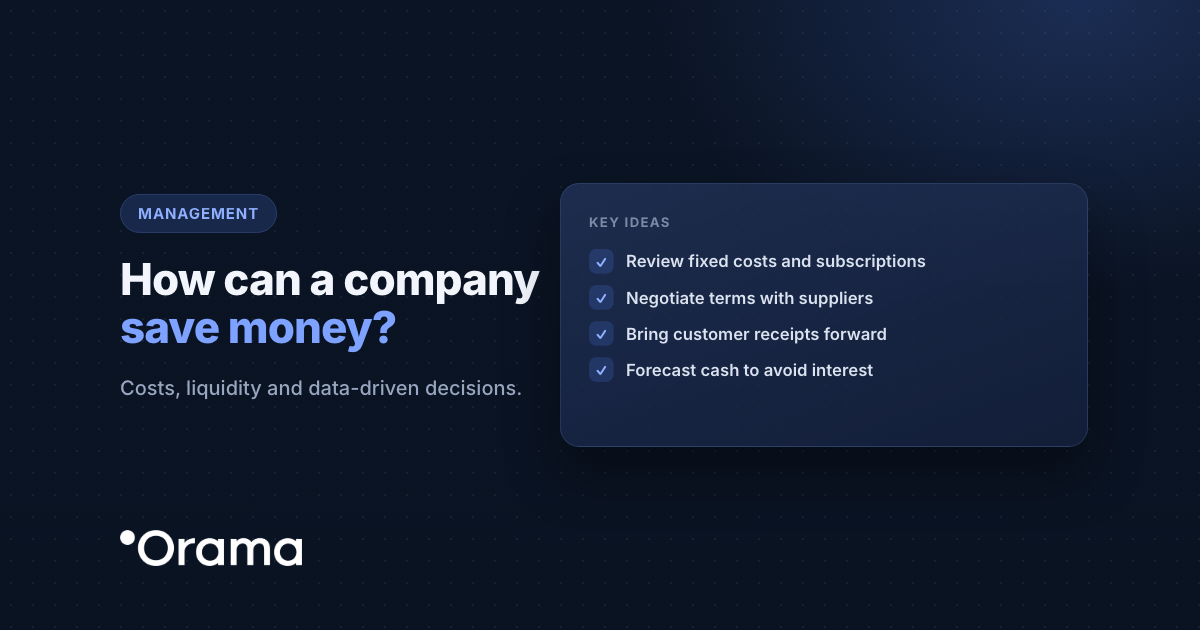
If the answer is no, start by making a cash flow forecast. It will show you your cost structure (fixed and variable), which items you can cut, and let you base your decisions on data, not assumptions.
How can a company save money?
1. Manage basic expenses correctly
Today, there are many platforms and tools to compare prices and services of our supply providers (such as electricity, gas or telecommunications). For commodities, it is highly advisable to make this comparison so that you can choose the cheapest provider in the market.
As we mentioned earlier: starting with the most basic savings can have a big impact. Do the right research and hire the most optimised service for you. Ask about bundled services too: getting telephone, internet and web hosting from the same company is often cheaper than paying for them separately.
2. Reduce fixed assets
Convert as much of your fixed expenses as possible into variable ones. For example, do not invest in offices for more than what is necessary: you can rent them for months, days or even hours. At this point you can also add renting and leasing to cover investment needs in cars and computer equipment, and look for free tools that suit your needs or SaaS (pay-per-use) solutions instead of investing in software packages.
With leasing, as well as keeping your company’s cash free, many contracts include repairs, upgrades and maintenance of the equipment.
Another key is, if your company needs to use a payment system for your business, compare the costs very well, as most entrepreneurs choose a POS from their bank because the exchange rate is better than a payment gateway, but the fees are higher and in the end it can be more expensive.
3. Strategic costs
Once the operational adjustments have been made, it is time to take a step forward and think about whether the structure of the company (such as the product portfolio, the markets in which it operates, etc.) is absolutely essential.
In other words, beyond the operational cuts, it is also important to rethink the strategic ones. How can we continue to operate with lower costs? Do I still make this product? Rethink if it makes sense to produce that product/service and if it really makes sense what we are doing.
Therefore, adjust the portfolio of products and services, and eliminate unproductive lines.
4. Hiring incentives
Take advantage of the hiring bonuses that exist at any given time and that can result in significant savings. For example, social security bonuses if you have personnel dedicated at least 85% to research, R&D or technological development activities.
As these incentives change often, it is best to have an adviser who tells you which ones are available to you: it would be a pity not to apply for them simply because you did not know about them.
5. Commitment to digital accounting
More and more companies can be managed more effectively with the new SaaS. Compared with traditional management, you will reduce operating costs and gain agility.
Go paperless whenever you can: scanning documents and issuing electronic invoices cuts printing, courier, postage and storage costs, and it is also faster and safer.
6. Automate processes
The new tools allow you to automatically perform many processes that used to be done manually. Making the change improves efficiency and reduces the risk of errors that can cost you money.
For example, tools such as Zapier or Make automate repetitive or administrative tasks by integrating with the most widely used applications (CRMs, ERPs, Google Docs, email…). They will not cut costs directly, but your team will save time and can focus on the tasks that really add value.
These six possible solutions can help to understand how a company can make savings.
More ideas to reduce fixed and variable costs
Fixed costs
These make the difference in the long run:
- Outsource secondary functions: an SME does not need departments that are not part of its core activity. Each department needs space and staff, so it can be cheaper to outsource tasks such as human resources, marketing, administration or auditing.
- Cut small non-essential expenses: many small expenses add up to significant savings. Review what you do not really need and what you should keep.
- Look after and repair equipment: correct use and timely repairs extend the useful life of IT equipment and delay the purchase of new units.
- Sell what you no longer use: if you upgrade equipment or materials, you can earn some income by selling them on second-hand platforms.
- Manage employee expenses: set guidelines for company cards, set limits and review monthly expense reports to avoid misuse and costly mistakes.
Variable costs
- Negotiate with your suppliers: they usually offer discounts to their most loyal customers or to those who buy larger volumes. Buy in larger quantities only if your future cash needs allow it, and research which supplier is the best and the cheapest so you can negotiate with information.
- Ask for discounts: many suppliers have volume or early-payment discounts they do not advertise. Ask what conditions you need to meet to get them.
- Apply the principles of Lean Management: the aim is to avoid waste in your processes and improve them continuously. Resources that expire or are wasted cost money.
- Collect part of the payment in advance: if you give your customers credit, consider asking for a deposit with each purchase. You will reduce the risk of non-payment, improve your cash flow and spend less effort chasing invoices.
If you need cash in the short term: 7 emergency measures
When cash is tight, these measures buy you months of breathing room. Apply them with your cash flow forecast in front of you:
- Separate necessary from expendable expenses: identify those that are not urgent or bring little benefit and cut them to extend the life of your business.
- Delay your payments: talk to your most approachable suppliers to see if they will accept a delay on the next invoice.
- Renegotiate terms with your suppliers: you could, for example, offer a longer contract in exchange for a longer payment period. Getting 30 more days of average payment period from a supplier is pure oxygen for your company.
- Rent instead of buying: even if the financial cost is slightly higher, spreading the payment over several months protects your cash. Today it is possible to lease almost any type of asset.
- Adjust new investments: think twice, three and four times about whether you really need them now, as they will put further strain on your future cash position.
- Plan your VAT: calculate every month the VAT you will have to pay in the coming quarters so that it does not catch you by surprise and, if you need to, ask your adviser about requesting a deferral or instalment plan from the tax authority.
- Review salaries, starting with your own: payroll is usually a major expense. Being the first to take a pay cut sets an example; adjustments for the rest of the team should be a last resort, because companies exist thanks to the people in them.
Once you have applied these measures, update your cash flow forecast to know how many payments you will have in the coming months and, therefore, the minimum sales you need each month to keep the business afloat. With that figure you can set very concrete targets and align your team to achieve them.
Orama allows you to have a complete and forward-looking view of your company’s expenses. This will make it easier for you to analyse which expenses your company’s cash is going on (and will go on).
In a 30-minute, no-obligation demo, we show you how to create future forecasts and learn how a company can save money.