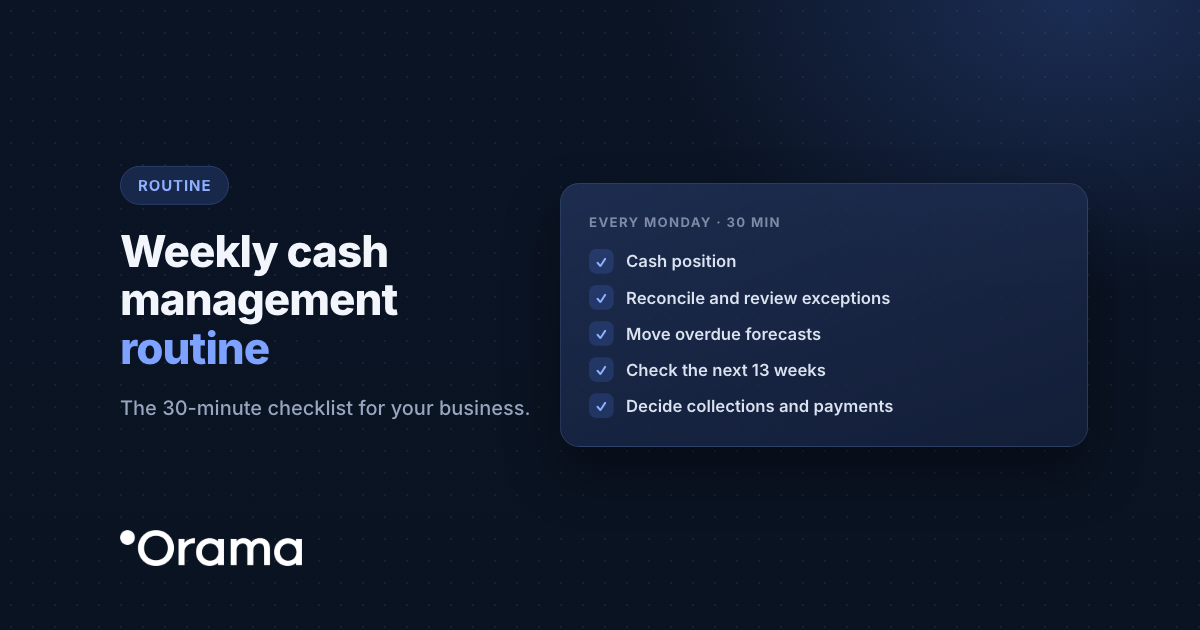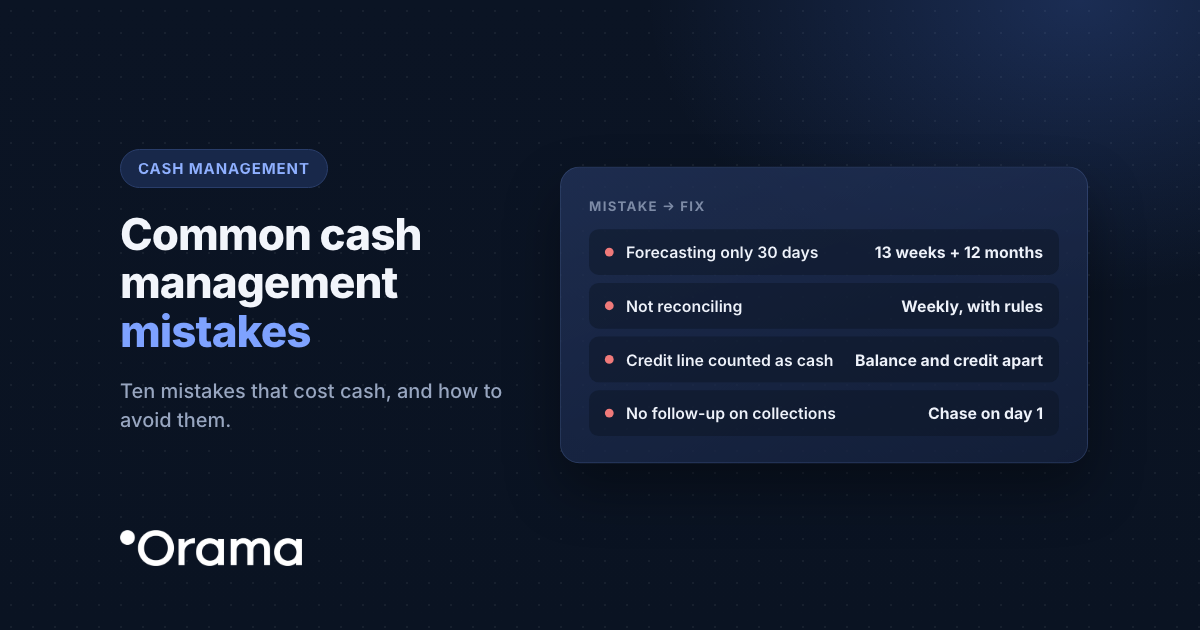

The cash management mistakes that cost a small business the most are almost always the same: confusing profit with cash, forecasting too short, not reconciling, counting financing as your own money and not chasing customer payments. You can avoid all of them with a 13-week and 12-month forecast, a weekly reconciliation and a fixed 30-minute routine.
In this post we go through the ten most common mistakes, why they happen and what to do to avoid them. For the full picture, start with the cash management guide for small businesses.
1. Deciding with the income statement instead of cash
A small business can close the quarter with a profit and still not have the money to pay salaries. It happens when sales are collected at 60 or 90 days and costs are paid earlier, or when the profit has gone into stock or an investment.
How to avoid it: before any decision with real impact (hiring, buying machinery, paying dividends), look at the cash forecast, not just the profit. We explain it in why cash is more important than profit.
2. Forecasting only next month
With a 30-day forecast, peaks arrive by surprise: quarterly VAT, corporate income tax, annual bonuses, the renewal of a yearly insurance policy or the low season. By the time they show up in the forecast, there is no room left to negotiate.
How to avoid it: work with two horizons. 13 weeks, week by week, for day-to-day operations; and 12 to 24 months, month by month, for decisions. If you are starting from scratch, the 13-week template gives you the structure.
3. A forecast nobody updates
This is the most frequent mistake in companies that already forecast: the spreadsheet was built in January and by April it no longer looks like reality. Late customer payments stay on their original date, unexpected payments are missing and the forecast stops being useful.
How to avoid it: every week, review the overdue forecast items that have not happened and move them to their new likely date. We cover this in updating outstanding balances.
4. Not reconciling (or reconciling at month-end)
Without reconciliation you don’t know which payments have come in, which have gone out or where the forecast is drifting. Left until month-end, it becomes a job of several hours that keeps getting postponed.
How to avoid it: reconcile every week and automate the repetitive part with rules (by description, amount or customer). That way you only review the exceptions. More in automatic reconciliation.
5. Counting financing as your own cash
Looking at the “available” figure without separating your own money from credit gives a false sense of security. And the day a credit line is not renewed, that cushion disappears overnight.
How to avoid it: in your cash position, show the balance in your accounts, the available credit and the total separately. Keep the renewal dates of credit lines and loans in the forecast, and review them three months in advance. If you use other short-term financing, record it properly too, so you can see how it affects what is really available.
6. Leaving collections for when there is time
Many small businesses invoice late, don’t chase until an invoice is weeks overdue and don’t know how many days it takes them, on average, to get paid. Every day of delay is money you are lending to your customers.
How to avoid it: invoice on the day of delivery, chase from the first day overdue following a fixed sequence and measure your days to collect. You’ll find practical ideas in how to reduce days sales outstanding (DSO).
7. Paying suppliers early (or haphazardly)
Paying each invoice as it arrives looks tidy, but it uses up cash earlier than needed and makes forecasting impossible. Paying late, on the other hand, damages the relationship and can make purchases more expensive.
How to avoid it: group payments into one or two fixed days a month and pay on the agreed due date. If you need longer terms, negotiate them in advance, not by simply paying late.
8. No defined minimum cash buffer
Without a reference figure, it is hard to tell whether a week with little cash is a problem or not. Decisions are made on gut feeling and, often, too late.
How to avoid it: set a minimum balance, for example the equivalent of one or two months of fixed payments (salaries, payroll taxes, rent and loan instalments), and mark it in the forecast. That way you know how many days of cash on hand you have and which week you get close to the limit.
9. Mixing up companies, or not seeing the group
In groups of companies, it is common to keep each company in its own spreadsheet with no combined view. Or the opposite: adding everything up without separating intercompany loans, which inflates the group’s cash.
How to avoid it: use the same categories in every company, put intercompany transactions in their own line and consolidate everything in a single view. We explain it in how to see the cash of a group with several companies.
10. Only looking at cash when there is a problem
If cash is only reviewed when the account is in the red, every solution is expensive: urgent financing, discounts to get paid sooner or delaying suppliers.
How to avoid it: a fixed routine of 30 minutes a week and one hour a month. You’ll find the checklist in weekly cash management routine.
Summary: mistake, warning sign and fix
| Mistake | Warning sign | Fix |
|---|---|---|
| Deciding on profit | “We make money, but there’s no cash” | Cash forecast before every decision |
| Forecasting 30 days ahead | Nasty surprises with taxes and bonuses | 13 weeks + 12–24 months |
| Forecast not updated | Nobody trusts the spreadsheet | Weekly review of overdue items |
| Not reconciling | You don’t know what has been collected | Weekly reconciliation with rules |
| Financing counted as cash | Credit lines expiring without notice | Balance and credit shown separately |
| No follow-up on collections | Days to collect going up | Chase from day one |
| Haphazard payments | Cash falling for no clear reason | Fixed payment days |
| No minimum buffer | Decisions on gut feeling | Minimum balance in the forecast |
| Group not consolidated | Inflated group cash | Same categories, intercompany loans apart |
| Only looking in a crisis | Urgent, expensive financing | Weekly and monthly routine |
Anonymised example
A technical services company with €2.5M in revenue closed the year with a profit, but in February it had to take out an urgent credit line. When it reviewed its cash management, it found three of these mistakes at once: a forecast of only one month (it missed the corporate income tax payment falling together with fourth-quarter VAT), no follow-up on collections (its days to collect had gone from 48 to 71 in a year) and supplier payments made as soon as invoices arrived. With a 13-week forecast, weekly chasing and two fixed payment days a month, within six months it brought its days to collect down to 55 and stopped drawing on the credit line.
How Orama helps
Orama connects to 100% of banks in Spain and 3,000+ across Europe and Latin America, and updates balances and transactions up to 4 times a day. It automatically reconciles between 90% and 99% of transactions, brings in invoices from your ERP with their due dates and gives you a 13-week and a 12, 18 or 24-month forecast, with scenarios. Connect our MCP to ask Claude or ChatGPT about your cash. Start your 7-day free trial, no card.