
Cash management in a small business means knowing every day how much money you have, how much you will have over the coming weeks and months, and which collection, payment or financing decisions you need to take so you never run out of cash. It rests on five pieces: a daily cash position, a 13-week and a 12–24-month forecast, reconciliation of bank transactions, management of collections and payments, and control of your financing.
This guide explains each piece with examples, the indicators worth watching, a weekly and monthly routine you can copy, and which tools fit each company size. It is written for managing directors, finance managers and accounting firms working with small and mid-sized businesses and groups with revenue of up to about €50M.
Contents
- What cash management is and why it matters
- 1. The daily cash position
- 2. The forecast: 13 weeks and 12–24 months
- 3. Reconciling transactions
- 4. Collections and payments
- 5. Financing: credit lines and short-term debt
- If you have several companies
- The indicators worth watching
- Weekly and monthly routine
- How to set it up in one week from scratch
- Anonymised example
- Tools: Excel or software
- Common mistakes
- Frequently asked questions
What cash management is and why it matters
Cash is the money the company has available: what sits in the bank and what you can draw from your credit lines. Managing it is not the same as keeping the books. Accounting records what has already happened and tells you whether you make a profit. Cash management looks ahead and tells you whether you will be able to pay.
A small business can be profitable and still run out of cash. It happens when customers pay at 60 or 90 days while payroll, taxes and suppliers are paid sooner; when a large purchase lands in a slow sales month; or when a credit line is renewed late. So the question cash management answers is simple: how much cash will I have each week over the coming months, and what do I do if it falls short? For a refresher on profit versus cash, read why cash is more important than profit and what cash flow is and how it is calculated.
Good cash management has three direct effects:
- No surprises: you spot tight weeks early enough to chase a payment, push back a payment or draw on financing.
- Lower financing costs: if you know when you need money, you borrow only what you need and stop paying interest on lines you don’t use.
- Confidence for banks and partners: a solid forecast is the first thing a bank asks for before renewing or extending a line.
1. The daily cash position
It all starts with knowing how much money you have today, adding up every account at every bank. It sounds obvious, but many small businesses work it out once a week, logging into each bank and copying balances into a spreadsheet.
A useful cash position separates three figures:
| Figure | What it includes | What it is for |
|---|---|---|
| Account balance | Your own money in current accounts | What you can pay without borrowing |
| Available credit | The unused part of your credit lines and other financing facilities | Your financing cushion |
| Total available | Balance + available credit | How far you can go today |
Ideally, balances and transactions arrive from the banks on their own, with no files to download. With a read-only PSD2 bank connection, data updates several times a day and the figure is always current. If you still download bank statement files by hand (e.g. Norma 43 in Spain), we explain the difference in do you need statement files to forecast cash?
2. The forecast: 13 weeks and 12–24 months
The forecast is the heart of cash management. It works on two horizons that complement each other:
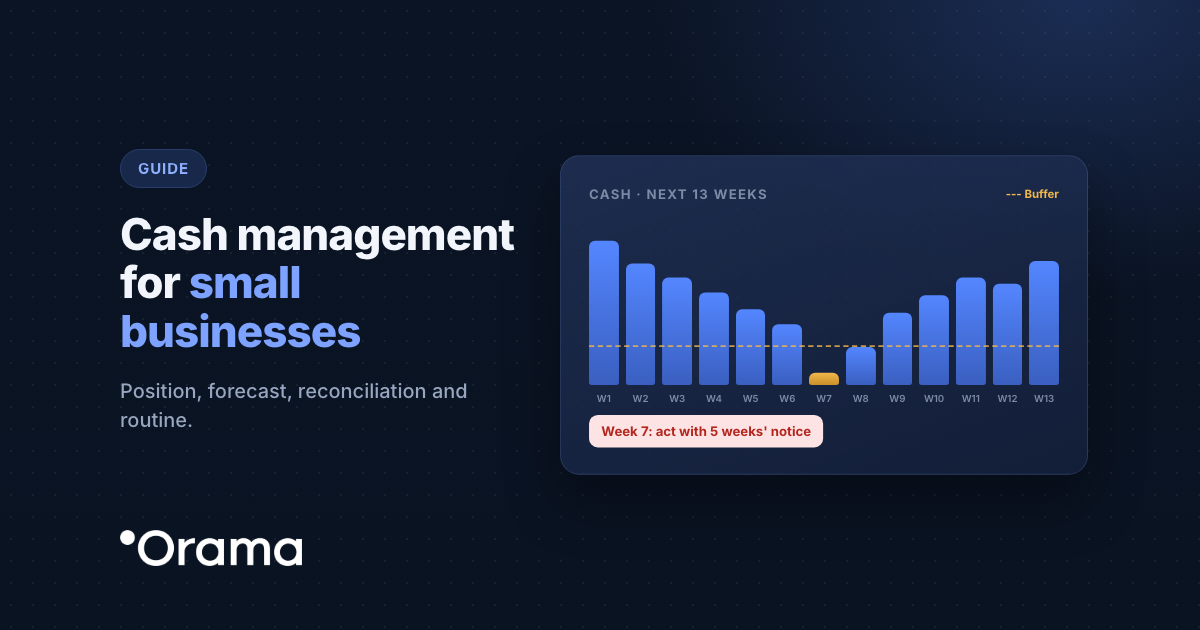
- 13 weeks (short term, week by week): to run day-to-day operations. This covers collections on issued invoices, supplier payments, payroll, payroll taxes and social security, taxes, loan instalments and direct debits. This is where specific shortfalls show up: “in week 6 I’m €18,000 short”.
- 12, 18 or 24 months (medium term, month by month): to make decisions. Hiring, investment, renewing credit lines, seasonality, growth. Here you work with recurring items, estimates and scenarios (“what if a large customer pays 60 days late?”).
How to build the forecast, step by step:
- Start from today’s balance across all accounts.
- Group collections and payments into items (sales by customer or product line, suppliers, staff, taxes, financing…) and group those items into categories. Keep the same ones all year so you can compare.
- Load what you already know: outstanding receivable and payable invoices with their due dates, payroll, instalments and taxes with their calendar.
- Estimate recurring flows that have no invoice yet: expected sales, utilities, rent.
- Review every week what happened, what didn’t and why, and adjust.
If you want to start without software, our 13-week cash flow forecast template in Excel gives you the week-by-week structure with alerts for negative cash and for your minimum cushion. For the longer horizon, read annual cash flow forecasts, how to make a cash flow plan in 5 steps and scenario forecasting.
3. Reconciling transactions
Reconciling means assigning each bank transaction to its item and, where relevant, to the invoice or forecast entry that explains it. Without reconciliation the forecast drifts: a collection that already arrived still shows as pending, or a payment is counted twice.
Proper reconciliation lets you do three things:
- Compare forecast and actual and see where your forecasts go wrong.
- Spot late collections (overdue forecast entries with no matching transaction) and update their date, as we explain in updating outstanding balances.
- Close the month in minutes instead of hours.
Most of it can be automated with rules: by description, by amount, by the tax ID or name of the customer or supplier. With well-defined rules, most transactions reconcile themselves and you only review the exceptions. If you sell online, income from Stripe, PayPal, Redsys or Adyen arrives bundled and net of fees: how to reconcile payment gateway payouts covers the detail. More on the process in automatic reconciliation.
4. Collections and payments
The cheapest way to improve your cash position is not to borrow. It is to collect sooner and pay on time, not early.
Collections:
- Invoice on the day you deliver or finish the service, with a clear due date.
- Review overdue invoices every week and chase from the first day late, in a fixed order (reminder, phone call, second notice).
- Agree short terms with new customers and offer direct debit or payment in advance where your sector allows it.
- Track your days sales outstanding (DSO) and how it moves. We explain how in how to reduce your days sales outstanding.
Payments:
- Group supplier payments into one or two fixed days a month: it is easier to forecast and to negotiate.
- Pay on the agreed due date, neither before nor after: paying early uses cash for no reason, and paying late damages the relationship.
- Put a tax calendar in the forecast (VAT, withholding taxes, corporate income tax) so no quarter catches you off guard.
5. Financing: credit lines and short-term debt
Short-term financing is part of cash management, not a separate topic. What matters is having it inside the forecast, so you know how much real headroom you have left.
- Credit line: a facility you draw down and repay as you need. It counts as available credit. Watch the renewal date: if it is not renewed, it disappears from your available cash overnight.
- Loans: put every instalment in the forecast with its date, and check maturities a few months ahead.
- Fees and interest: these are not known in advance. You can add an estimate to the forecast if you like; interest is usually charged separately, under another description, and reconciled in the bank charges category.
We go through the options in types of bank financing for small and mid-sized companies.
If you have several companies
In a group, cash management adds a layer: seeing the cash of every company at once without losing the detail of each one. The keys are to use the same categories in all of them, to keep intercompany loans in their own item so they don’t inflate the forecast and, if any company works in another currency, to consolidate in the group currency with the exchange rate applied to the view. We cover this in how to see the cash of a group with 3 or 4 companies and, if you run several sites, in franchises with one account per location.
The indicators worth watching
You don’t need twenty indicators. These six give you the full picture:
| Indicator | How it is calculated | What it tells you |
|---|---|---|
| Days of cash | Available cash ÷ average daily payments | How many days you can keep paying without collecting anything |
| Runway | Cash ÷ net monthly burn rate | How many months you have left if nothing changes |
| Lowest forecast balance | The lowest point of the 13-week forecast | The tightest week and how much you are short or over |
| Days sales outstanding (DSO) | Receivables ÷ sales × days in the period | How long you take to get paid, on average |
| Days payable outstanding (DPO) | Payables ÷ purchases × days in the period | How long you take to pay, on average |
| Forecast vs actual variance | (Actual − forecast) ÷ forecast, by item | Where your forecasts miss |
More detail in how many days of cash does my company have, runway: how long will my business last and treasury KPIs.
Weekly and monthly routine
Cash management works when it is a habit. Here is a routine that takes half an hour a week and an hour a month:
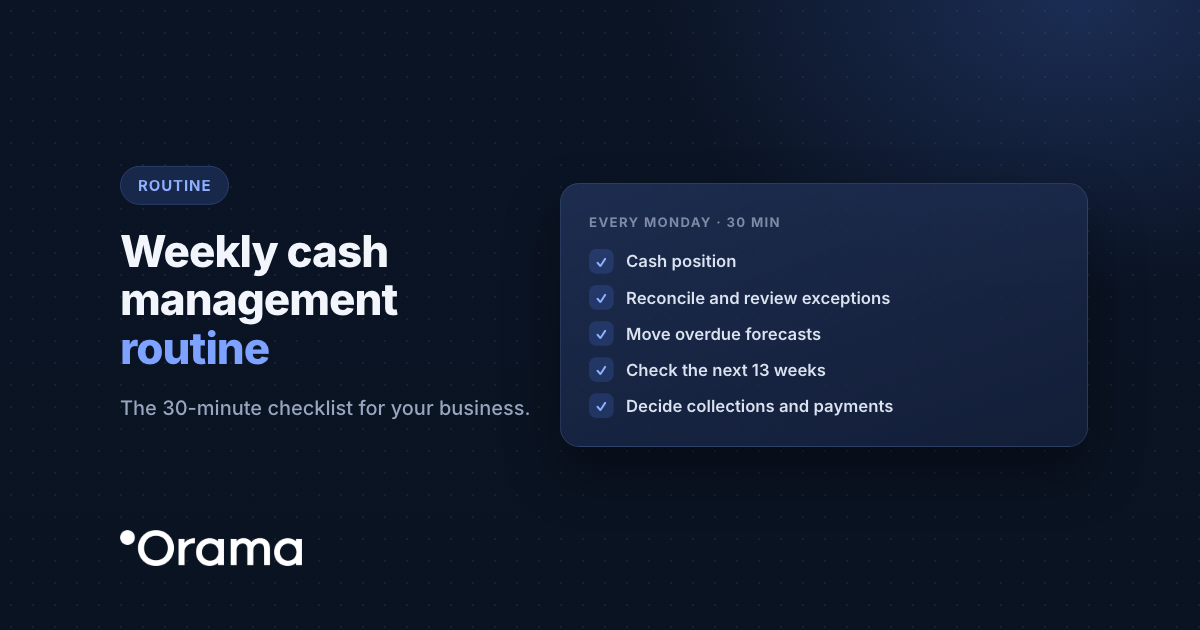
Every week (30 minutes):
- Check the cash position and available credit.
- Reconcile pending transactions or review the exceptions.
- Review overdue forecast entries that didn’t happen and update their dates.
- Look at the lowest balance over the next 13 weeks and decide whether you need to act.
- Chase overdue invoices and set the week’s payments.
Every month (1 hour):
- Compare forecast and actual by item and fix the estimates that miss.
- Update the 12–24-month forecast with what you know about sales, hiring and investment.
- Review the indicators (days of cash, runway, DSO, DPO) and their trend.
- Check credit line and loan maturities for the next 3 months.
- Send a summary to management, partners or your accountant.
The detailed version, with timings and owners, is in weekly cash management routine: the 30-minute checklist.
How to set it up in one week from scratch
If you have no control in place today, don’t try to do everything at once. This order works for most small businesses and can be completed in five working days spread over a week:
| Day | What you do | Result |
|---|---|---|
| 1 | List every account, card, credit line and loan, with its bank, limit and maturity | You know what you have and where |
| 2 | Define 15–25 items grouped into categories (sales, suppliers, staff, taxes, financing, other) | A shared language for forecasting and reconciling |
| 3 | Classify the last 3 to 6 months of transactions into those items | A history that shows what you really collect and pay each month |
| 4 | Load outstanding receivable and payable invoices, the tax calendar and loan instalments into a 13-week forecast | Your first lowest forecast balance |
| 5 | Extend the forecast to 12 months with the recurring items and set the minimum cash cushion you want to keep | A view of the year and a clear alert |
From then on, the weekly routine keeps everything up to date. Two tips that save a lot of work later:
- Decide your minimum cushion before you look at the numbers. A common benchmark is one or two months of fixed payments (payroll, payroll taxes, rent and loan instalments). That way the forecast tells you something specific — “in week 9 I drop below my cushion” — not just “cash is going down”.
- Few items, well defined. With too many, reconciliation slows down and nobody keeps the forecast up to date. You can always split an item later when you need more detail.
If your company has an ERP, use the fact that it already holds invoices with their due dates: don’t type them in again. And if you work with an accounting firm, share the monthly forecast with them: it helps them plan taxes and anticipate financing needs. In how an accounting firm can manage its clients’ cash we explain it from the other side.
Anonymised example
A distributor with €6M in revenue, 3 banks and a €150,000 credit line ran its cash in Excel and updated it on Mondays. When it built the 13-week forecast with the real due dates of customers and suppliers, a problem it hadn’t seen came up: in week 7 the quarterly VAT payment, an extra salary payment and two large supplier payments fell together, and the lowest balance dropped to −€42,000, even though the credit line still had headroom.
With five weeks’ notice, it could act without rushing:
- It chased two overdue invoices worth €25,000 that were 20 days late.
- It moved one supplier payment to week 9, within the agreed terms.
- It planned to draw €30,000 from the credit line for that week only, instead of keeping it drawn all quarter.
The lowest balance stayed positive, and financing costs were lower than the previous year, when the credit line had been drawn as a precaution for months.
Tools: Excel or software
The right tool depends on size and complexity:
- Excel is enough if you have one bank, around 100 transactions a month and a single company. Start with the 13-week template.
- Cash management software pays off when you have several banks, hundreds of transactions, an ERP that issues the invoices, several companies, or you need forecasts beyond one year with scenarios. The saving comes from not downloading statements, not reconciling by hand and having the forecast always up to date.
- An enterprise treasury management system makes sense with centralised international treasury, bulk payments, physical cash pooling and dedicated teams, and usually needs an implementation project.
We compare them in detail in Excel or treasury software? When a spreadsheet is enough and when it isn’t and in what treasury software for a small business should include.
How Orama does it
Orama is cash management and forecasting software for small and mid-sized businesses, groups and accounting firms. It covers the five pieces in this guide:
- Cash position: connects to 100% of banks in Spain and 3,000+ across Europe and Latin America via read-only PSD2, and updates balances and transactions up to 4 times a day.
- Forecast: a cash flow table with a 13-week view and 12-, 18- or 24-month forecasts, with scenarios. AI helps create the forecast for an item from its history and your instructions.
- Reconciliation: automatically reconciles between 90% and 99% of transactions with rules, and breaks down Stripe, PayPal, Redsys and Adyen payouts.
- Collections and payments: integrates with ERPs such as Odoo, Holded, Sage 50, Sage 200, Business Central and Oracle NetSuite to bring in invoices and their due dates.
- Financing and groups: credit lines inside the forecast, and consolidation of several companies in the currency you choose.
Start a 7-day free trial, no card. You can also connect our MCP to ask Claude or ChatGPT about your cash.
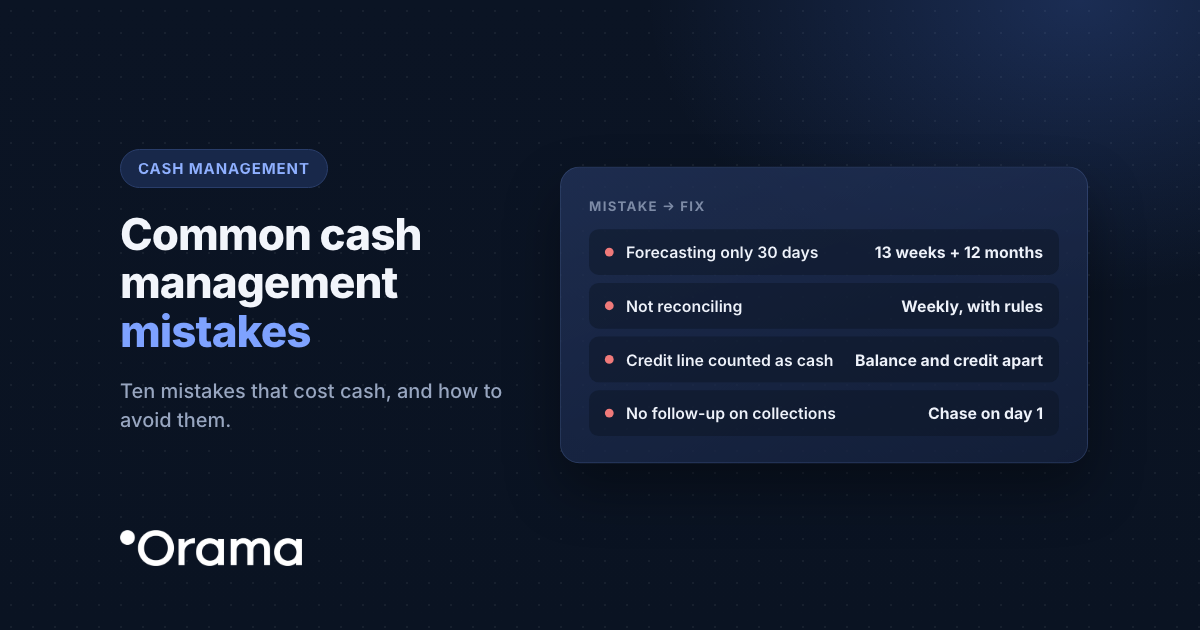
Common mistakes
- Confusing profit with cash and deciding from the income statement.
- Forecasting only one month ahead and finding out too late about tax peaks and extra salary payments.
- Not reconciling and working with a forecast that no longer looks like reality.
- Counting financing as your own cash or losing track of when a credit line expires.
- Looking at cash only when there is a problem.
We go through them one by one, with how to avoid each, in common cash management mistakes in small businesses.