In order to make strategic decisions, it is vital to have indicators and data that allow you to choose the most appropriate option for your company. Good financial management is crucial to survive the competition and a volatile economy, so the financial control of a company is one of the most important activities for startups and SMEs.
WHAT IS THE FINANCIAL CONTROL OF A COMPANY AND WHY IS IT IMPORTANT?
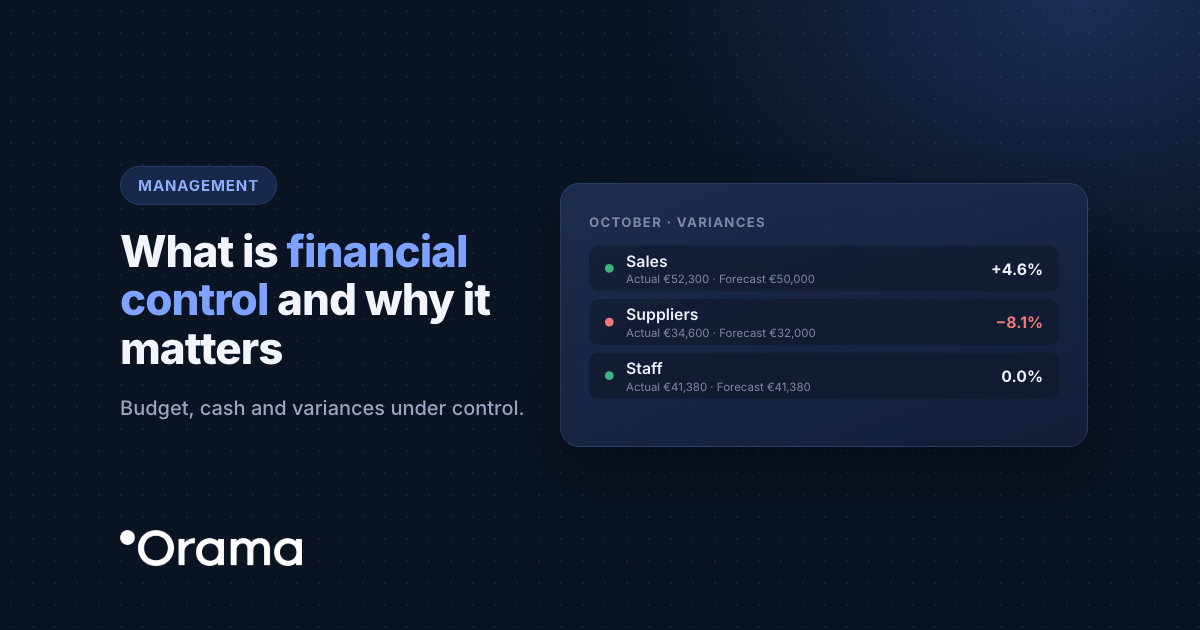
Financial control is an instrument for monitoring the company’s finances. It serves to control the accounts, and to know the expenses and where the income comes from. Therefore, it is an analysis and study of the actual results in order to prevent unforeseen events and irregularities and, if found, to know how to take the most appropriate decisions to correct them.
Specifically, it compares the results obtained at given moments with the company’s medium and long-term objectives and strategy, and makes sure there is no shortfall between expenses and revenue.
Hence the importance of good cash management: it is a key element that will allow us to define the survival of the company.
OBJECTIVES OF FINANCIAL CONTROL
- Check that everything is going well: Simply put, sometimes financial control simply serves to confirm that everything is going well and that the objectives are being met if there are hardly any significant alterations and in the line that had been set.
- Detection: Even if no errors are being made, serious deviations may occur. Therefore, it is important to have control of all areas or production processes of our company to detect these possible errors.
- Prevention: Financial control facilitates the early diagnosis of possible misalignments of the overall financial plan. Therefore, corrective measures can be implemented to avoid these situations of misalignment.
- Corrective Utility: Thanks to all the information we have gathered, the monitoring of the main KPIs and the projection of cash flow behaviour, it will be possible to detect deviations or unforeseen situations, as well as to establish specific corrective measures.
TYPES OF FINANCIAL CONTROL
There are three main types of financial control:
Immediate or directional financial control
It consists of knowing the company’s financial situation in as much detail as possible at a given moment. It is usually based on the general financial statements prepared at the close of each financial year. Its aim is to prevent any deviation that could compromise the company’s overall objectives.
Selective financial control
This is more specific monitoring: instead of looking at the company as a whole, it reviews each department separately. This way you can see that one area is meeting its financial objectives while another needs corrective action. In central departments such as HR, administration or technology, the focus is usually on spending limits; in sales or operational departments, on the sales process itself, so that the budget is met or exceeded.
In medium-sized companies this is usually done by the financial controller under the supervision of the CFO; in small companies without a finance team, it is the CEO’s job.
Subsequent financial control
It analyses the results once the year has closed, to see whether the financial strategy has worked or whether budget decisions are needed for the following year. How far have we deviated from our sales target? Have we incurred higher costs? Is it justified? Have we achieved the expected margins?
WHO IS IN CHARGE OF THE FINANCIAL CONTROL OF A COMPANY
In general, CFOs (Chief Financial Officers) are responsible for designing and controlling financial strategies, as well as coordinating everything related to accounting, maintenance and optimisation of economic resources.
They are responsible for knowing how to reduce, manage and optimise expenses through rigorous control.
HOW TO KEEP FINANCIAL CONTROL OF A COMPANY
For your company’s finances to meet the objectives you have set, we recommend these tips:
- Reduce your average collection period as much as possible. The longer you take to get paid, the more you have to finance that lack of liquidity, either with credit or with your own cash surplus, and that always has a cost. Collecting sooner brings what you invoice closer to what you actually receive.
- Avoid late-payment interest on taxes. Keeping your tax obligations up to date avoids penalties and unexpected costs. There are ways to defer tax payments, but try not to fall behind what you have agreed with the tax authority, as late-payment interest is high.
- Control one-off expenses. They are hard to foresee, sometimes weigh heavily on the total and are easily left out of the annual budget, which leads to significant deviations.
- Assess new expenses financially. SMEs often copy the spending of large companies and buy tools they never make profitable. Before buying, build a simple business case:
- Estimate the direct and indirect cost of the tool: not just the purchase or subscription, but also staff time, learning time and the data it needs.
- Estimate the cost of your current process. The saving is often smaller than it seemed.
- Estimate the additional income it will bring and when it will reach your bank account, because you will have to finance the cost until it starts to pay off.
- Outsource processes that are not the core of your business, such as accounting or payroll. For an SME it is usually more efficient to rely on a specialised external team than to bring them in-house before reaching sufficient size.
- Invest in financial control tools. Financial control can be done manually, but it is complex; financial control software automates processes and gives you proper reporting. To estimate the impact of your decisions, you can simulate them with Orama’s scenarios.
- Plan your financing. Taking on debt is not a bad thing: it can help you grow when you need liquidity. Include interest rates and repayment periods in your projections to check whether the amount is enough and, above all, whether the business will be able to repay it.
For more tips on reducing expenses, take a look at our post on how a company can save money.
4 ACTIONS FOR GOOD FINANCIAL HEALTH IN A YOUNG COMPANY
When a company starts out, it is normal for the founding team to handle all the finances, and many are caught out by a lack of cash when something unexpected happens or because they do not track how efficient their spending is. A lack of liquidity is one of the most common reasons why startups close. These four actions help to avoid it:
1. Keep control of your cash
Knowing how much cash you have in the bank today is not enough: decisions must take cash projections into account. Track your burn rate and your runway, which tells you how many months the company has left, and keep a safety buffer for the unexpected.
2. Project your expenses
A very common early mistake is not projecting expenses. Without that projection you cannot foresee how your cash will behave or make the business model more efficient. Try the reverse exercise too: what would happen if you kept your planned expenses and sales fell short of the plan? Many sales plans are too optimistic.
3. Have a financial plan
It is one of the company’s most important documents. Without it you will not know whether you are drifting from your objectives or why, and you will not be able to correct course in time. You need cash flow control and projections to make decisions based on data, not gut feeling.
4. Plan your funding round in good time
Keeping cash under control tells you how much runway you have left and, therefore, when you will need financing. With a tight runway you will have little room to negotiate and could end up accepting unfavourable terms out of necessity.
IN SUMMARY
In short, it is important to have good financial control, since a misalignment in the company’s finances can jeopardise the general purposes of the organisation, lose an advantage over the competition and, in some cases, even jeopardise its own survival.
If you want to know how to implement a financial control strategy, you can read our post on How to make a treasury plan in 5 steps?
With Orama you can keep track of your treasury, with your banks updated up to 4 times a day, to complement the financial control of your company. Book your demo with one of our specialists to see how Orama can help you.